Published Updated
An interview with Canela Party organisers Beto Pérez, Álvaro Fernández and Antonio Mata. We want to find out what lies behind one of the most distinctive festivals on the Spanish music scene: who makes it possible, how the project began and why Canela Party has become an essential date for thousands of music fans.
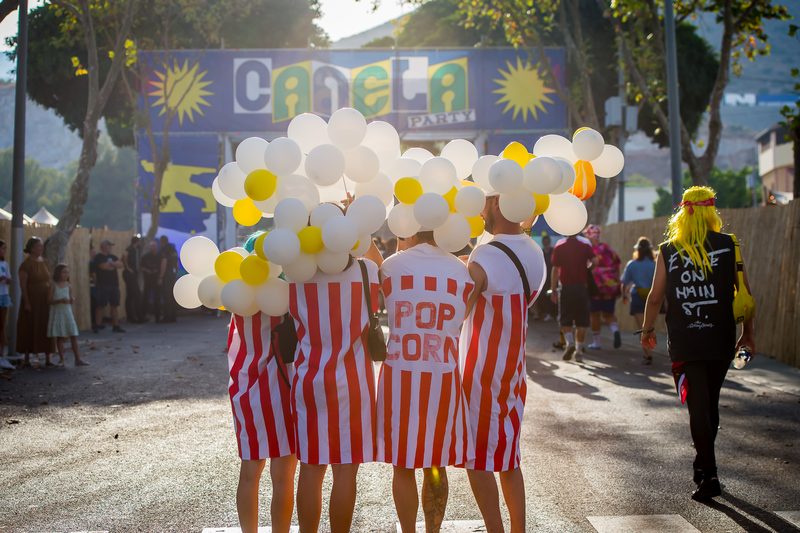
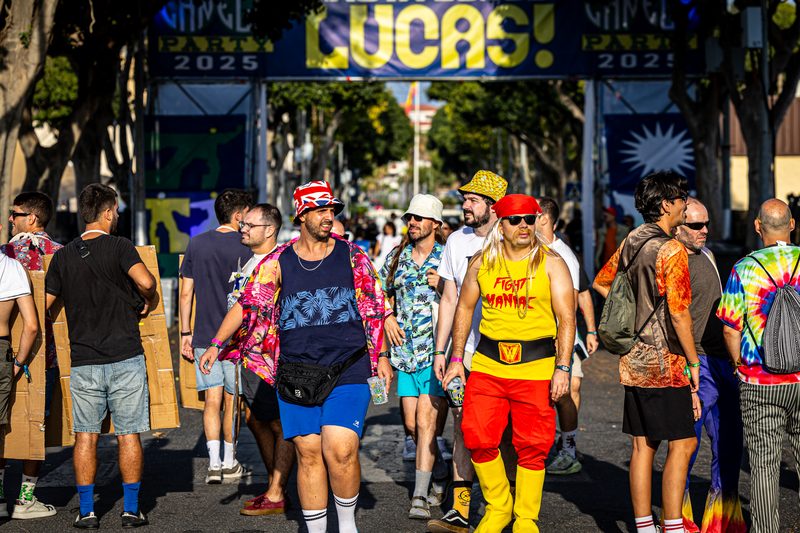
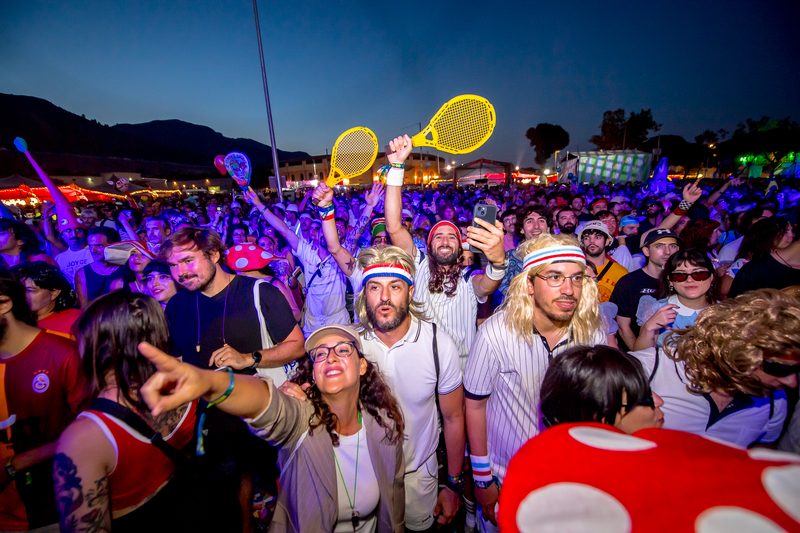
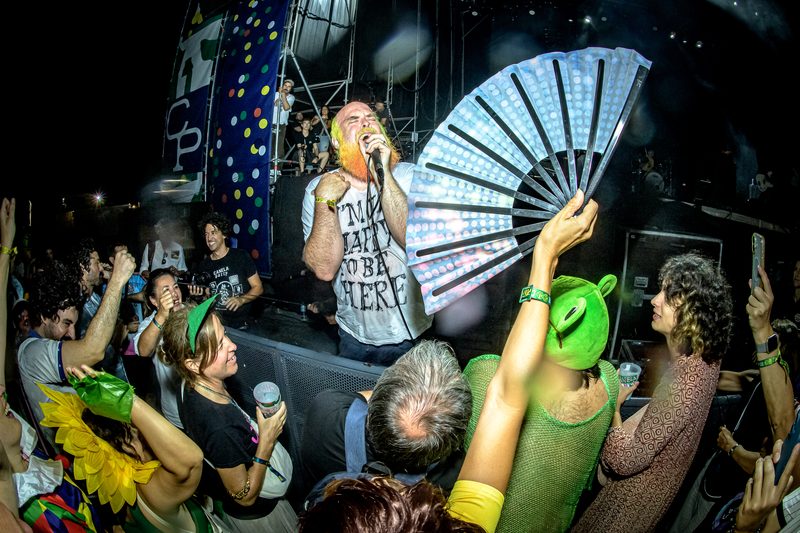
With a format as original as it is unpredictable, the festival gives audiences the chance to discover dozens of bands across a wide range of styles. Far removed from repetitive, predictable line-ups, Canela Party embraces risk, variety and surprise, turning every edition into a unique experience. And, as if that were not enough, fun is guaranteed by one of its defining features: the now legendary fancy-dress party.
Interview
Valdi How exactly did the idea for Canela Core begin? Was it really a joke among friends, or was there already an intention to do something different?
Álvaro: It was, first of all, a party among friends. There was no intention of doing something different; it simply responded to the need to do something fun.
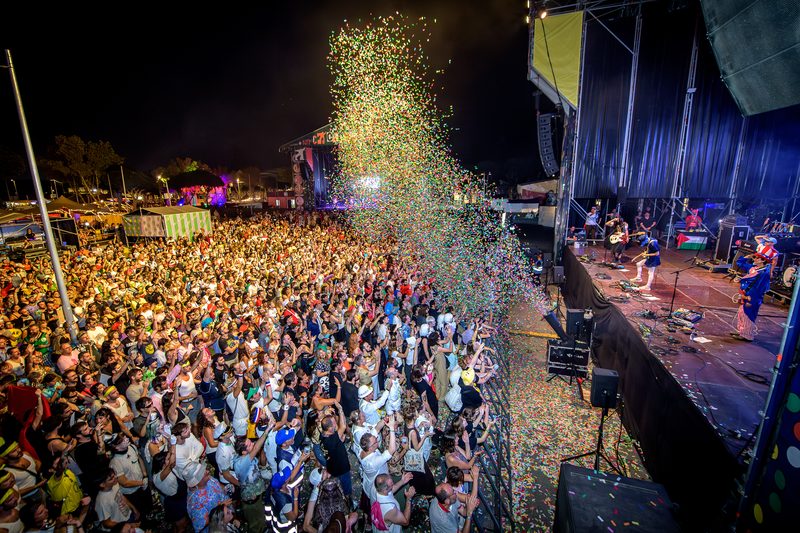
The idea was born because there was a band in Malaga, The Skirmish Society, in which we played screamo. At that time it was a style that had hardly any presence in the city and, so that people would not be scared with so much testosterone, so many screams and so much distortion, we decided to give the concerts a much more festive and even comical tone. We started playing every gig in costume, throwing confetti and sweets.
From there we thought: if we are having such a good time with this format, why not do a festival in which the rest of the bands also dress up? And why not involve the audience as well? That was really the spark that gave rise to the festival.
At that time we got together several friends and different collectives from the city. I was with The Skirmish Society, Beto organized concerts on his own and there were other bands that also wanted to be part of the project. We got to work with a very rudimentary production and a totally punk operation. There were plenty of willing hands and huge amounts of enthusiasm, but very little experience of how to organise a festival.
It was all very innocent, very DIY and very punk, but that was precisely why it came together in a very authentic, fun and genuine way. It was simply a party among friends.
There was never any intention to create something groundbreaking, and we certainly never imagined that Canela Party would become a leading festival over the years, one day featuring internationally renowned bands on its line-up.
In the end, everything was born from innocence, from the desire to do things and to have fun in a city where there was almost no music industry. If you wanted something to happen, you had to do it yourself. That was, in essence, the true spirit with which Canela Party was born.
“Everything was very innocent, very DIY and very punk. Yet that was precisely why it came together in such an authentic, fun and genuine way. It was simply a party among friends.”
Valdi What were you tired of in the festivals and gigs of the time that made you say, “we’re doing this our own way”?
Álvaro: To put it in context, this was 2007. We were very young and we had not been to that many gigs or festivals. Living in a city like Malaga, most of the concerts we went to were those we organized ourselves or those put on by our friends and by the people who had come before us, people a little older than us who had been promoting concerts in the city for some time.
At that time it was much easier to put on a gig than now. There was more permissiveness, virtually any bar could host a concert and there was a much more active musical life: there were more venues, more shows and many more opportunities to play. Today, however, the situation is much more complicated.
By then we had barely gone to festivals. We had made the odd trip to Madrid or Barcelona to see bands that we loved, but when we went we did not go there thinking about what we would improve or change if we organized one ourselves. We were simply blown away by being in a venue and watching a band we loved play. I think that by that time I had already been to the San Feliu Hardcore Fest, which was always a reference for us.
That's why there was also no idea of doing a festival "in our own way." Among other things because we didn't even know what the right way to do things was. As I mentioned before, that first edition was organised in a very punk, very innocent way, driven by enthusiasm and excitement. There was a lot of energy, but also a great deal of chaos and disorganisation. Still, it went well. It was great fun and, above all, very authentic.
“There was no idea of making a festival ‘our own way’, because we did not even know what the right way of doing things was.”
Valdi Where did the name “Canela” and the fancy dress come from? Was it a provocation aimed at the posturing in the hardcore scene?
Álvaro: Well, the subject of fancy dress has already been explained in the previous question. As for the name Canela, it came from an expression that we used a lot at the time to refer to anything that seemed especially good or fun. We said things such as “Ayer conocí a una chavala to canela”, “Ayer me lo pasé to canela” or “He visto una peli to canela”—using “Canela” to mean that something was especially good or fun. It was an expression very much our own and, honestly, we did not give the name much more thought. The “Core” came from the fact that that first edition had a greater presence of bands from the hardcore arena, although there were already bands of other styles. So it was as simple as putting the two words together: Canela Core. There was no naming brainstorm or anything like it; it came about entirely naturally.
As for whether there was a certain provocation aimed at the posturing of the hardcore scene, yes, there was a little bit of that. In the big cities, more importance may have been placed on aesthetics or belonging to a particular tribe. In Málaga, by contrast, there were fewer of us and people mixed together with very different tastes within independent and underground music. People from hardcore, punk and metal mixed together... and there was a certain irony towards that image of the "macho-core" or even of the "emo-core". It was the time when the emo aesthetic, with impossible bangs and all that image so marked, was very fashionable.
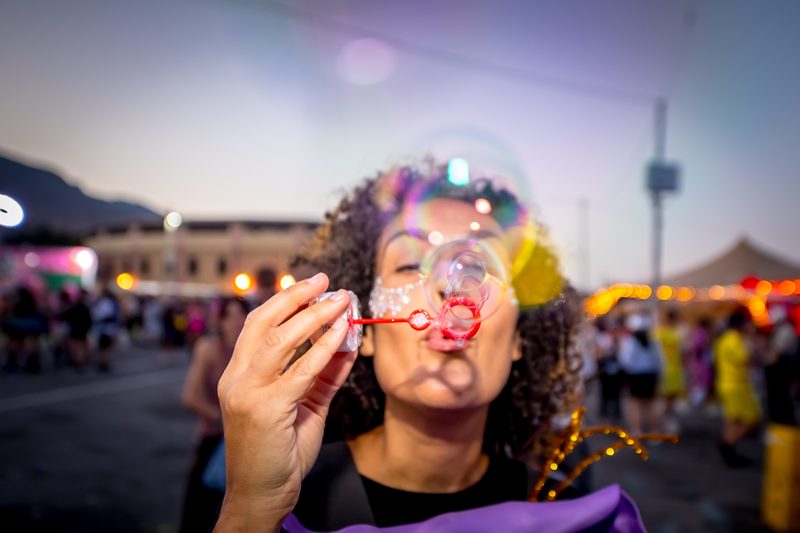
All that was quite funny to us because we thought that appearances were not what mattered; having fun was. From the first year there was an intention to go against the grain of that idea, to say that you did not need a particular look to be part of a scene. On the contrary, the message was: dress up. Use the costume to show your true self, to shed that carefully constructed image and explore a freer, more creative and more fun facet of yourself. It was a way to express yourself through humor, imagination and creativity.
In fact, I remember that that first year we made a small blog whose motto was something like: “Soy Canela y tu flequillo me la pela”—roughly, “I’m Canela and I couldn’t care less about your fringe.” We played with that idea that here we came, above all, to listen to music and to have fun. We also wanted to change the focus a little bit and that the bands would not be the only protagonists. The audience, the attendees, also had something to contribute through their fancy dress, their outfits and even their own performances. Somehow, they all became part of the show.
“The message was the opposite: dress up. Use the costume to show your true self, shed that carefully constructed image and explore a freer, more creative and more playful side of yourself.”
Valdi At what point did you say, “this is no longer a gig; this is a festival”?
Álvaro: Well, actually the first year featured nine bands, so that was already a festival. In fact, in the second edition, in 2008, we reduced the number of artists a little because in 2007 we finished at a ridiculous hour. As everything had been organized in such an improvised way, we started, in quotation marks, to professionalise the project a little.
And I say "in quotes" because Canela did not really become professional until many years later. What did happen was that new people, a little older than us, who had attended the first edition, had had a great time and told us: "The idea that you have had is very good, we would like to collaborate, but maybe it is necessary to put a little order." At that time Sergio and Juanma joined us, who contributed a different vision: to prioritize quality over quantity. I do not mean that the bands were better or worse, but to do fewer things, but do them better.
Thus the second edition was born. The drawback was that we moved to a more professional venue and there we were forbidden to throw confetti, with which one of the most characteristic elements of the festival disappeared completely.
The following year we got a public space, or semi-public, the Caseta de la Juventud of Torremolinos City Council, which no longer exists today. The curious thing is that this place, once demolished, is currently Canela Party’s production parking area.
In 2009 we were able to put the festival together practically from scratch. We installed our own bar, hired the bar staff, who were a whole group of friends, and that year we managed to bring one of the most important Spanish bands of the moment, DeLorean, in addition to many other very interesting bands. That was a turning point. It was such a fun edition that we thought: "This works, this is very good".
In addition, people from outside Malaga began to come because word had already spread that it was a proper party. We even brought our first international band, Adorno, from Portugal, whose drummer was Braulio Amado, who happens to be responsible for Canela Party’s 2026 visual identity.
I remember that feeling perfectly. Everything was still very chaotic, but at the same time tremendously fun. At the end of the festival it was all covered in confetti, fancy-dress debris and a real disaster, but we all had a smile from ear to ear. We thought, “That was so much fun. This is worthwhile and it has to continue.”
“That was a turning point. It was such a fun edition that we thought: ‘This works. This is really good.’”
Valdi No clashes, affordable prices and a family atmosphere: are those non-negotiable red lines? Has maintaining them cost you money?
Álvaro: Well, I’m going to start with the last question. In general, Canela, since 2007, has cost us a lot of money. When we started the festival there was no intention that it would become our way of life, let alone make money from it. The idea was simply to do something nice in our city to enjoy it ourselves. There was no commercial motivation at all.
In fact, throughout the year we also organized concerts for the love of it. We wanted to bring to Malaga the bands that we liked because, simply, those concerts did not exist. All that cost us money, time and, many times, also problems with our families, partners and friends, because we never had time for anything.
Since almost all those gigs lost money, including Canela itself, the members made a monthly contribution (I don’t remember exactly how much it would be, perhaps about 25 euros) to avoid surprises. It had already happened to us to finish a festival without enough money to pay the bands what we had agreed and to have to go to the ATM to pay out of our own pockets to keep our word to them.
So yes, Canela cost us money, lots of money.
Regarding the first part of the question, about the no-clash policy and the family atmosphere and if they are red lines, the answer is yes.
The no-clash policy dates practically from the beginning of the festival. Since it was born as a one-day event and in a single venue, the concerts necessarily went one after another: a band ended, a stage change was made and the next one began.
When in 2022, after the pandemic, we moved to the open-air site and introduced two stages, we thought that that was one of the hallmarks we didn’t want to lose. We decided that even with two stages, the concerts would continue without overlap.
We think it's a matter of respect for someone who buys a ticket. If someone pays for a line-up with a series of artists, the fair thing is that they can see every artist if they want to, without having to choose between two concerts that are scheduled at the same time. For us that has always been very important and still is.
That does not mean that the audience has to be watching concerts without stopping. That is precisely why we have the DJ area, which works very well and offers a different space to take a break from live music, chat, dance or simply change the atmosphere.
As for the family environment, it is also a priority for us. We love that people of any age can come: kids, older people and even whole families. We believe that music should be enjoyed with friends, with family or with anyone you want. There is no age limit on enjoying a festival.
As for prices, we try to keep them as low as possible. Obviously, the cost of living rises every year and so do artists’ fees, production and all the expenses associated with a festival. There are things that are inevitable.
Even so, our goal has always been to make Canela as affordable as possible within an industry that is increasingly expensive. We want whoever comes to feel that what they receive is worthwhile and, above all, that they do not feel deceived.
It is also important to understand that the price of entry, by itself, does not cover the real cost of such a festival. It is essential that the bar works in order to balance the accounts. But even there we try to be consistent with our way of understanding the festival.
We want to offer well-known brands, quality drinks and, above all, a bar team that is treated well and paid properly. We believe that when a worker is happy, they also treat the audience better, and that ends up having an impact on everyone’s experience.
In the end, it all responds to the same idea: to put people at the centre. It doesn’t matter whether we talk about the worker, the artist or the attendee. The important thing is that everyone feels looked after and that Canela remains a safe, enjoyable and fun space, not a project designed solely to maximise profits.
We could raise prices much more, as other festivals have done, and we would probably earn more money. But, so far, we have preferred not to do so because we believe we would lose part of the essence of the project.
That does not mean that some things may change in the future. To this day none of us makes a living solely from the festival, although hopefully one day we can build a sufficiently solid structure to make it sustainable without having to renounce the values with which it was born.
Right now we are still learning to make the most of the new venue. Although it has been four years since the return of the festival after the pandemic and the transfer to the Torremolinos fairground, with two stages and a much bigger production, the truth is that it was a huge leap.
Perhaps we were not fully prepared to grow so fast and during these years we had to make an important effort to absorb and recoup all that investment which, in a way, was quite kamikaze.
Our philosophy remains to grow little by little, consolidate each step, better control the expenses and make cuts only where the audience will not notice, never in the experience of the festival.
In short, we try to offer the best possible festival at the most reasonable price possible. After all, it is exactly the type of festival that we ourselves would like to attend as audience members.
“Ultimately, it all comes down to the same idea: putting people at the centre. Whether we are talking about a worker, an artist or an attendee, what matters is that everyone feels looked after and that Canela remains a safe, welcoming and fun space—not a project designed solely to maximise profits.”
Valdi The line-up mixes avant-garde flamenco, punk, metal, indie… How do you decide that something “is Canela” and something else is not? Is there a filter beyond the music itself?
Álvaro: Well, we always say, half-jokingly, that we are a very selfish festival, in the sense that we bring in the bands that we like, period. That is, not every suitable band can be there, and the line-up does not fit a single mould. There are many bands that stay out because we don’t have enough budget or, as we usually say, the financial resources needed to afford certain fees.
We are lucky enough to be people who like music in general, but especially the music made with care and passion. We like punk, hardcore, flamenco, indie, post-punk, pop, electronics... In short, we enjoy very different styles. There are even occasions when one of us is less excited by a particular band, but we always try to function democratically and seek consensus. Sometimes that consensus does not come at all, but you see your fellow organisers genuinely excited about adding a band and you think: "I'm not particularly excited, but I'm not going to oppose it either."
In the end, the first filter is obviously the musical: that we like the band. And then there is another much more abstract filter, which is to ask ourselves whether or not that proposal fits Canela’s spirit. That’s what we often comment on: “This band could be Canela” or “this other not so much”.
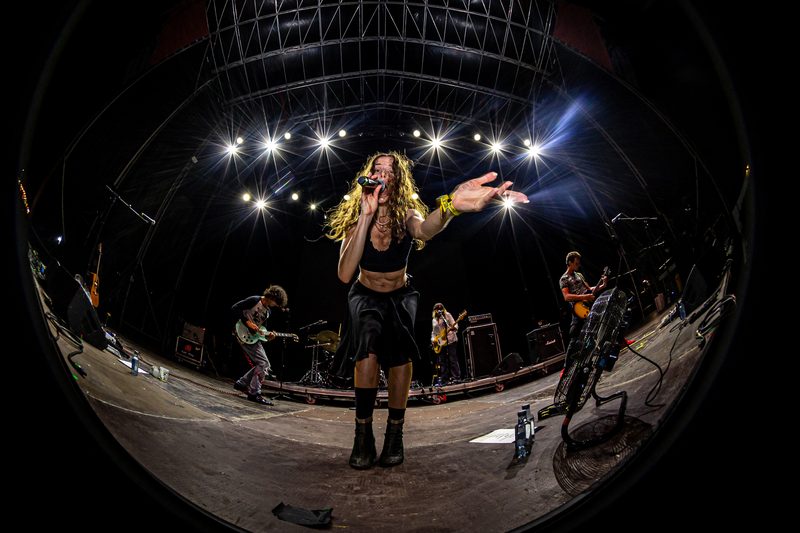
But, as has already been seen over the years, the festival has found room for everyone from Deafheaven to Big Thief. That is, we manage a very wide musical spectrum. We have also featured urban music and flamenco. Actually, the filter is not so much about genre, but because we like it, feel that it fits the festival and we believe that it can connect with our audience.
And, of course, there is a much more painful filter, which is the financial one. There are many bands that we would love to bring, but that are simply beyond our reach. That is the filter that hurts the most, but it is also a reality that we have to assume because we do not have the financial resources of other festivals.
Even so, fortunately we are a much-loved festival. I think that, among other things, both Spanish and international agents who already know us know that the vision of Canela is very pure; it does not respond to a commercial approach. They know the size of the festival, know what our economic capacity is and understand that we offer what we can offer.
That is why, on many occasions, especially with Spanish bands, it has been they themselves who have made an effort to be at the festival. They also know that playing in Canela brings them credibility, prestige and, in some way, positions them as a “cool” band.
With international bands everything is more complicated, but after so many years working with foreign artists and with their offices, they already know us. At first you arrive completely new, but now they know how we work, what our format is, what our philosophy is and that we do not have public funding or major sponsorships, beyond the support of Son Estrella Galicia. That makes it possible, sometimes, to adjust their conditions taking advantage of other dates in nearby European festivals and, in this way, make an appearance at Canela possible.
In addition, the word of mouth works very well. We have had many Canadian bands thanks to that first visit by Metz, who spoke about the festival to Holy Fuck; then Holy Fuck told Preoccupations and, from there, the recommendation was passed on to other American and even Australian bands. All that kind of stuff also adds up and has contributed to building the reputation Canela enjoys today.
“The first filter is obviously musical: we have to like the band. Then there is a much more abstract filter—asking ourselves whether that proposal fits the spirit of Canela.”
Valdi You are completely different from the standard three-day summer festival built around headliners. Do you think audiences are tired of that model?
Beto: Well, it's a model that, on the one hand, makes sense, doesn't it? Especially in the case of mega-festivals. They book one or more very big names each day, which are the ones that really sell lots of tickets and weekend passes, and then complete the line-up with the rest of bands.
The funny thing is that, at least for us, the most interesting thing about these festivals is usually in the small print. That’s where you often discover genuinely good acts. However, the wider audience usually overlooks those bands because they go exclusively to see the big headliner. There are people who queue for hours or stand in the front row just to see that artist and, when the concert ends, they leave. And it’s a shame because, in most macrofestivals, there are many very interesting bands that are simply not headliners.
It's a little sad that people do not dig deeper into the line-up of these types of festivals, because there are really very worthwhile acts.
What if the audience is starting to get fed up? Well, it’s hard to say. In Spain there must be about a thousand festivals and, curiously, many of them are practically the same. They’re the same bands touring from one place to another, hired in packages by the same promoters, with very similar line-ups.
Even so, these festivals continue to sell a great many weekend passes, probably because an important part of the audience that comes to them does it not just because of the music, but because they have become a meeting point, the place to be, or the wristband they can show off all summer.
I think that a lot of people will continue to go to these kinds of festivals because, after all, they became fashionable. Previously, those who went to festivals and concerts were almost music obsessives. Today, in many cases, the festivals have become a showcase for brands, almost like an open-air shopping centre, full of commercial spaces and promotional actions. And, unfortunately, in many of them the music has taken a back seat. And that, honestly, is a shame.
“For us, the most interesting part of those festivals is usually the small print. That is often where you discover genuinely great artists.”
“Unfortunately, at many of them the music has taken a back seat.”
Valdi You have held 18 editions. What was the hardest moment in keeping the festival alive: the pandemic, changes of venue or rising costs?
Beto: Well, without a doubt, the worst moment we experienced in all these years was in 2023, when we suffered a kind of hurricane, a very strong gale, which forced us to stop the festival for several hours. At that time we lost a lot of money. A festival like ours depends to a large extent on the bars and, the nearly four and a half hours of shutdown left a major hole in our finances. In fact, we could almost say we are still recovering from the income we lost and had been counting on.
Without a doubt, it has been the most difficult moment we have gone through. The two years of the pandemic were difficult as well, but somehow they served us to continue taking steps forward, continue backing the project and return in 2022 in a completely new format, outdoors.
Initially, in 2020 we had planned to hold it in the bullring, but the project evolved, we incorporated more bands and, finally, in 2022 we settled next to the Plaza de Toros, in the Torremolinos fairground, with those two L-shaped stages, where there are never overlaps between concerts. We are very happy with that venue and, in addition, every year we learn new things. We hope to be able to continue there for a long time and to improve edition after edition.
It is also true that the costs have gone up a lot. That affects us, like everyone else, but especially because we are a mid-sized, or even small, festival that tries to keep prices lower than those of other larger festivals.
We spend a great deal of time thinking about it and, on many occasions, we find it difficult to maintain certain prices because, in the end, the numbers do not add up. But we want the festival to continue for many years and sometimes there is no choice but to adjust the price of the tickets so that the project remains viable.
So here we continue, with the enthusiasm undimmed, hoping that Canela will continue for many more years thanks to the support of all the people who make it possible.
“Without question, the worst moment we have experienced in all these years was in 2023, when something like a hurricane—an extremely powerful gale—forced us to stop the festival for several hours.”
Valdi Torremolinos has been home for years. What is it about the fairground venue and the Costa del Sol that fits the Canela spirit so well?
Beto: We started there in 2022. Well, I’m going to say that we started, but it’s not really true, because as far back as 2009 we did an edition in the Caseta de la Juventud, which, curiously, no longer exists today. It was demolished and now that space is used as a parking area for the production of the festival and other services. Still, some characteristic elements remain recognisable, including the venue’s distinctive green colours.
It is a space that, for us, is very comfortable. Besides, Torremolinos is a very special place. We are there because, to be honest, in Málaga we never received too much attention. We never received support, no one would even meet us so that we could explain the project and, in general, we have had very little presence in the local press. It is as if the festival did not exist for them.
However, in Torremolinos they did give us that opportunity. We really like the venue, we like the city, all its idiosyncrasy and the history behind it. We think it is a place with a lot of personality, very aligned with the spirit and values of Canela. We feel that it fits perfectly with what we are as a festival.
And in the end, being able to celebrate the festival by the sea, at the end of the summer, seems to us the best possible way to see out that time of year.
“We love the venue, the city, its whole idiosyncrasy and the history behind it. We think it has a great deal of personality and is closely aligned with Canela’s spirit and values.”
Valdi Presented by SON Estrella Galicia and with design by Bráulio Amado, how do you choose brands and collaborators so that you can grow without “selling out”?
Beto: The truth is that we are extremely picky when it comes to sponsors and, I guess, precisely because of that, we have very few sponsors.
We have the support of SON Estrella Galicia, for which we are very grateful. It is a brand that, even before starting to collaborate with us, had already been interested in the festival and knew us. I think that, among brands of this kind, it is the one that communicates best, the one that really understands the music, the scene and everything that surrounds it. We are very happy with them.
For us, it is a very natural partnership. I mean that its product is beer and, at a festival, it makes perfect sense that it is present. Instead, we have received sponsorship proposals from very disparate brands, which have absolutely nothing to do with the music or the festival, and we have rejected them because they did not feel consistent with what we do.
It is something that, however, happens in many other festivals. A few days ago I was in one where there was a real estate developer who sold luxury houses, buildings and apartments. And, honestly, I don’t know what that has to do with a music festival.
I understand that there are festivals that seek to maximize income and, as long as there is money involved, any sponsorship is worth it. We don’t. We have a pretty strong ethical filter from the beginning and we prefer to have fewer sponsors, but they are really aligned with our philosophy.
As for design, for us to have Braulio Amado this year has been a real dream. We met him in 2009, precisely in that edition we did in Torremolinos, before starting to organize concerts in other venues in Malaga. He came as a drummer from Adorno, a Portuguese screamo band from the outskirts of Lisbon.
We met him there and, over time, Álvaro, who is also dedicated to design, developed a closer relationship with him. And, well, the bastard has become hugely successful. For me, today, he is one of the best designers in the world.
Thanks to that relationship of so many years, he knew the festival perfectly and kept a very good memory of that first experience. He had always wanted to collaborate with us, but he never found the time because of the enormous workload he had. We have tried practically every year, until this time he told us: “Okay, this is the year. I want to do it and, besides, I think I have time." The result has been an incredible design and, for us, it has been a real luxury to be able to count on him and everything he represents.
It's funny because this year he was working at the same time, on projects for Harry Styles, the Rolling Stones and also for Canela.
Having someone like Braulio has been very special. Actually, we pay a great deal of attention to the whole visual side. We all get involved, although it is true that Álvaro, by his profession, is the one who knows that side best. Thanks to him we have also met great designers with whom we have worked in other editions, such as Ales Div, Realmente Bravo, Pol Rodellar (from Mujeres), Cristina Daura & Jabier Rodríguez, Berto Fojo, Wear Beard, Javi Medialdea… In fact, we have already chosen the person who will create the graphic identity of the edition of 2027 and we are already working on it.
It is essential for us to take care of that part and give it almost the same importance as the music line-up. We believe that the graphic identity of a festival says a lot about what it is and how it understands culture. And we think that this is another aspect that distinguishes Canela from many other festivals.
“We have had a strong ethical filter from the outset. We would rather have fewer sponsors, provided they are genuinely aligned with our philosophy.”
“We believe a festival’s visual identity says a great deal about what it is and how it understands culture.”
Valdi There were 19,000 people in 2025. Do you have a maximum capacity in mind that you do not want to exceed for fear of losing the festival’s essence?
Beto: We are selling 5,000 festival passes and 500 day tickets. That is, more or less, the capacity we have planned. It is true that we then need to add everyone who is part of the festival: bands, workers, press, guests and so on.
In the end, every day we can be around 6,000 people and that is the number we have in our heads. It is true that the venue can hold far more people—far more. With the current layout, we could easily reach about 11,000 or 12,000 people, so there is room for growth.
But right now we are not thinking about that. We are also not a festival that sells out immediately, as is the case with other festivals that have a single major draw capable of selling every ticket on their own.
Canela is a different, more specialized festival. We don’t have a major international act that alone is able to sell all the tickets. We could say that we often cannot afford to do it, nor do we want the festival to depend on it.
Obviously, we would love to have great international names that would help us make that leap, but the reality is that many of those bands are beyond our reach for the budgets we work with. We have zero euros of grants and we have a single sponsor who, although it treats us brilliantly and we are very grateful, remains that: a sponsor.
In the end, the numbers are what they are and we cannot grow beyond our means either. Of course we would love to have bigger bands and expand certain things, but I think that, with our budget and our limitations, we continue to make very good, distinctive line-ups with many acts that other festivals do not offer.
Also, fortunately, in Spain there are many small and medium festivals that are doing things very well. They are almost like sibling festivals and I think it is precisely those kinds of projects that people should support.
Then, of course, everyone is free to do whatever they want, but I do believe that we should be aware that big festivals often have far more support, grants and big sponsors. Perhaps the interesting thing would be for some of that support to be directed towards smaller festivals, which do things from a different perspective, with other values and with a more ethical way of working, rather than ending up supporting projects that are backed up by large investment funds or business interests that have little to do with music.
Unfortunately, in Spain there are many examples of this, and yet every year they continue to fill and sell thousands of tickets. I think that many times the public does not stop to analyze what is behind certain events or to separate their leisure from the realities that may be behind some companies or investors that finance them.
“We can have close to 6,000 people on site each day, and that is the figure we have in mind. The venue could hold far more—as it is currently arranged, we could easily reach 11,000 or 12,000—so there is room to grow.”
“But that is not what we are thinking about right now.”
Valdi The closing fancy-dress party is still going strong. Which traditions would you refuse to lose even if the festival became ten times bigger?
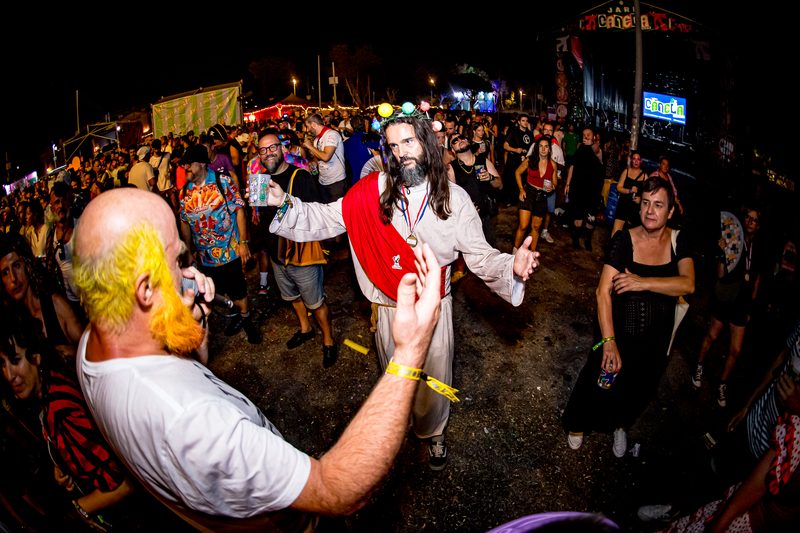
Antonio: The fancy-dress party is much more than a tradition; it is part of the origin of the festival. It is something that everyone identifies as one of its defining features and that, in my view, should never be lost.
Above all there is music, of course, but the combination of live music and fancy dress was precisely what gave rise to this madness that is the Canela Party. That combination is part of our essence.
I do not really think that we have many traditions to maintain as such, but rather a number of principles that are fundamental to us, for example, that there are no overlaps between concerts or that prices are, as far as possible, affordable.
These are aspects that make Canela different and that, if we want to call them traditions, then go ahead. But, above all, they are elements that are part of our way of understanding the festival and that we always want to preserve. Because if we ever lost that, it would no longer be Canela Party.
“The fancy-dress party is much more than a tradition; it is part of the festival’s origin.”
“Because if we ever lost that, it would no longer be Canela Party.”
Valdi For 2026 you talk about “consolidation and new developments”*. What kind of new ideas can you introduce without betraying Canela?
Antonio: Well, although it seems incredible, we are about to hold the eighteenth edition and next year will mark twenty years since that first edition that was held in 2007. Every year that passes and every year that Canela continues to exist is, for us, a great victory and almost a small miracle.
In that sense, we can say that with the passage of time the festival has become more and more consolidated. But, at the same time, it still retains an element of precarity, because it remains a self-financing project, we remain independent and have very little institutional support, outside funding or major sponsors. In the end, each edition involves taking small steps to keep the festival going.
As for new developments, the truth is that there are usually no big changes from one year to the next. This year, for example, the most important thing is that we are going to run for one day fewer: instead of the four days we have had in previous editions, this time there will be three.
This responds to the idea that the festival remains sustainable and to optimize our resources better. We believe it is a decision that all of us will appreciate, both the organising team and the audience.
For us, moreover, new developments do not always have to be major changes, but continue to improve year after year, correcting small mistakes, polishing details and ensuring the festival’s services continue to evolve, improve and become more professional.
“For us, new developments do not always have to mean major changes. They can mean improving year after year, correcting small mistakes, refining details and ensuring the festival’s services continue to evolve, improve and become more professional.”
Valdi Do you see a new generation coming through? Are you worried that the small venues and DIY bands you came from will disappear?
Antonio: We do see a new generation coming through. From the point of view of the public, it is true that we could have had the concern that, after so many years, the festival audience could end up getting tired or disappearing. But the truth is that we are seeing a steady influx of new people.
We can check with the statistics that we do through ticketing platforms. We see that the average age remains quite stable and, if anything, has fallen in recent years. And that is a reason to be very optimistic.
As for the festivals, I think that small festivals and DIY projects will always exist. Or, at least, that I want to believe. It is true that things are made more difficult for us every day, because the music festivals have become a big business. In recent years investment funds and mega-festivals, which are business models that generate a lot of money, have entered the picture and, from our point of view, also do a lot of damage to live music.
Live music has to remain something immediate and rooted in the street. Bands do not begin by making it big and playing directly on stage for 20,000 people. Any musician knows that the road starts by devoting many hours to rehearsing with friends in a practice room, playing in small bars, in small venues and gradually building a career.
I do not know, in Málaga’s particular case, the truth is that small venues are all but disappearing. Very few of them remain and many of them have had to move to industrial estates. And, well, this is also driven by the decisions made by our local councils.
But I think that music will always exist, and so will live music. If that were not the case, the truth is that it would be difficult to maintain hope. That is why it is very important that small venues continue to exist, that there are enthusiastic people willing to risk their time, their effort, their money and even their mental health to keep small festivals and independent projects.
It is also essential that social centres and self-managed spaces continue, because they play a very important role within the cultural fabric.
It is true that the current situation is worrying, but I want to believe that these things are cyclical. In the end, in one way or another, these small initiatives will end up finding their way and will continue to survive. At least, that is the hope we have.
“Live music must remain something close and rooted in the street. Bands do not begin by succeeding and playing straight away on stages for twenty thousand people.”
“That is why small venues must continue to exist, along with people willing to risk their time, effort, money and even their mental health to keep small festivals and independent projects alive.”
Valdi 15. If someone wanted to start an “anti-festival” today, what three pieces of advice would you give them that nobody else tells you?
Antonio: If someone wanted to start an anti-festival today, meaning an independent project, that does not respond to a commercial logic, that is not a macrofestival and that seeks something beyond the simple economic benefit, then yes, they absolutely could.
We believe, and I believe that we have shown over the years, that there is another way of doing things. That it is possible to organize a festival from another perspective, with other values and with a different way of understanding live music.
Having said that, I don't know if we are the most suitable to give advice to anyone, but I think the most important thing for anyone who wants to set up their own festival, whether it's something small, a project in their own town or simply an event with the music they would like to see live, is to do it with love, with passion and with the heart.
You also have to make a lot of effort, because nobody gives you anything. You have to work, spend many hours and make sacrifices. We continue to do it every year and, although it may seem the opposite, each edition remains as complicated as the last.
And then there is something that for me is fundamental: honesty: honesty with yourself and with the audience, because in the end the audience is part of the festival. Without them, obviously, the festival does not exist.
And we also have to be honest with the workers and with the musicians, with the bands. We are tired of seeing great festivals that take advantage of the artists, that offer them supposed visibility while they pay them a pittance, using that excuse to benefit from their work.
I think if you do things with love, effort and honesty, it is possible to keep going. Is it difficult? Extremely. But is it possible to do it? Yes.
“If you do things with love, hard work and honesty, it is possible to keep going. Is it difficult? Extremely. But is it possible? Yes.”
Valdi Last one: what makes you most proud about Canela Party that people on the outside do not see?
Antonio: I think we all always agree on something: Canela is, of all the things that we have been able to do in life, surely, one of the things that we are proud of most, in our personal lives.
The simple fact that Canela has been around for so many years is already a huge reason for pride, but it is also having kept it going is another and that we can maintain, as far as possible, the same conditions and philosophy that we had from the beginning, even though the festival has grown in numbers.
What is it that people on the outside do not see, but that makes us especially proud? Well, I guess, among many other things, we have managed to bring in all the bands that have played.
When we look back at the early years, the truth is that it is incredible. Fifteen or twenty years ago, if someone had told us that we were going to bring bands to Torremolinos like Dinosaur Jr., Superchunk, Viagra Boys or so many others, we would probably have laughed. We would have thought it was impossible, that it was completely crazy. But the truth is that it happened.
Anyone who is a promoter, who puts on gigs or who has tried to organize something related to music knows perfectly well how difficult it is to make a project sustainable. I was going to say profitable, but it is hardly ever profitable. Often, the real goal is simply to avoid going bankrupt and to be able to continue doing it year after year. And that is also a source of pride.
Sometimes there are people who, from outside, think that behind the festival there are major financial backing, large amounts of capital or a much bigger structure than there really is. Something curious also happens when someone tells us: "Bring this band" or "Bring the other." Many times we are not aware that behind bringing in a band there are a huge number of factors that have to fit in.
The budget, the band’s fee, the dates, the tour routes, the artists' availability... There are many pieces that have to fit together at the same time.
And especially with international bands it is even more complicated. Getting a band from Australia, the United States or any other place to come not only to Spain, but specifically to Torremolinos, to the south, has an added difficulty. Many times international touring routes do not pass through here. Even Malaga, sometimes, is left off those usual routes compared with other Andalusian cities such as Granada or Seville, which have a more established musical tradition and more established circuits.
That's why, for us, it's a huge reason for pride to look back and see all the bands that have gone through the festival and all those that keep coming. I think people value it and that means a great deal to us.
But, as I said at the beginning, our greatest pride lies not only in having brought in certain bands, but in having built something that is still alive after so many years and that continues to preserve the essence of Canela Party. And, of course, we hope it can continue for many more years.
“As I said at the beginning, our greatest pride is not simply having brought in certain bands, but having built something that is still alive after so many years and continues to preserve its essence as Canela Party.”