Published
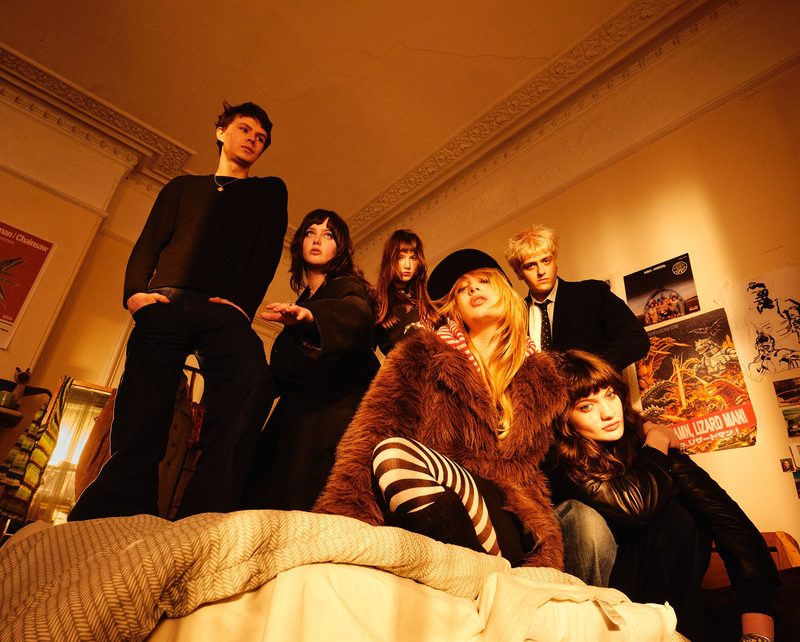
Billy Ward and Vera Leppänen started making music together in 2019, when they were fourteen and attending the same school. It has taken them seven years to release an album. Along the way came a first appearance on stage at sixteen, small venues, festivals, tours and improvised gigs: the kind of mileage most bands accumulate after their debut record, not before it.
A shifting line-up grew around Billy and Vera, one that did not settle until 2023 and is now completed by pianist Emmie-Mae Avery, guitarist Billy Doyle, drummer Lola Cherry and violinist Clio Starwood. Everyone except Starwood came from the same school; Avery joined after seeing an early incarnation of the group at what was her first concert, being told to get up and play keys, and never getting back down. Guitars, piano, synthesisers, drums, voices and that violin eventually formed a machine that is difficult to classify. Born in south London’s experimental scene, The Guardian soon placed them alongside the generation nourished by Black Country, New Road and black midi, although something of their own was already emerging: the search for that exquisite border between the beautiful and the noisy. And that delicate line is where they feel most at home.
Their concerts have earned a reputation for abrupt dynamic shifts, songs that begin like chamber pieces and end up buried beneath guitars, violent violins and distortion, members trading the spotlight and the constant feeling that someone is about to cause trouble. They do not make much effort to conceal the seams either: a mistake, a glance between musicians, silences or a small deviation all end up becoming part of the performance.
The explanation lies in their own history. Man/Woman/Chainsaw grew up playing live. A lot. The 2024 EP Eazy Peazy began to put a name to what was already happening on stage. "Ode to Clio" was a good example: initial delicacy, gradual growth and an almost punk final section driven by the violin, a song that mutates as it moves instead of fitting together in blocks.
Beneath that apparent collision lie complex arrangements, melodies and an increasingly evident pop component. That evolution has materialised in Cannonball, their first full-length album, released on 7 August through Fiction Records. It was produced by Margo Broom, associated with Fat White Family and Big Joanie, and Seth Evans, a collaborator of Geordie Greep and black midi. Eleven songs confirming that this is no longer only about perfecting the chaos of their early years: now they want big songs.

There are "Only Girl", "Nosedive" and the magnificently titled "Goddamn, Lizard Man!". The structures continue to avoid the conventional route, but the choruses grow, the melodies take up more space and the band play with an interesting contradiction: how to become more accessible without being domesticated.
At more than six minutes, "Nosedive" is the best example of that new scale. It develops slowly until it becomes something much larger than its starting point. The band themselves have presented the release of Cannonball as the culmination of years of touring and writing built around unpredictable structures and enormous choruses.
To understand them, though, you have to return to the stage. Ward himself has explained it plainly: they move along the fine line between pretty and noisy, jumping from one to the other, and it is that chaos that excites them. That combination of sonic violence and fragility explains more than any of the labels attached to them: art rock, post-punk, noise rock.
Man/Woman/Chainsaw play Canela Party in Torremolinos on Thursday 27 August, sharing the day with Unknown Mortal Orchestra, The Beths, Melody's Echo Chamber, Maruja, Basement and Baiuca. Surrounded by those names, they could go unnoticed, but they are one of this year’s line-up’s hidden gems. They then head to Belgium and a British tour that ends at London’s Electric Ballroom before crossing to the United States in the autumn.
By the time they step onto the Canela stage, twenty days will have passed since Cannonball was released. They arrive still discovering what those songs can do on stage, and for a group that has used live performance as a laboratory, that variable is tempting. Their ability to conjure a fine storm of noise is beyond doubt. What remains to be seen is what happens when a band that learned to grow within chaos discovers that it can write enormous songs too.