
Published
There was every reason to believe Ladytron's return to Liverpool would be no ordinary date. The band were back in their city of origin, playing live after a long break, just one day before releasing Paradises, their eighth studio album. Too many elements aligned for this to feel like another concert on another tour. There was a story here: a homecoming, a new chapter, a new record and a band with more than two decades behind it, seemingly determined—or at least willing—to show that it still had something to say.
In one sense, they made that perfectly clear. Not through grandeur, theatricality or overwhelming intensity; Ladytron chose another route. They delivered a solid, enjoyable and beautifully executed concert, though a less spectacular one than might be expected from a band long associated with elegant coldness, synthetic sophistication and immersive visuals. Put simply, it was a far better concert than spectacle: more rewarding to hear than to watch.
The night began with “Kingdom Undersea”, one of the new album's most overtly eighties tracks, and from that first move it was clear Ladytron had not come to Liverpool for a nostalgia exercise. New material occupied almost half the set and sounded impeccable: emotional, vivid and convincing. That became one of the return's most interesting conclusions. The group—Helen Marnie in particular—seemed completely at ease with the songs, not promoting a record out of obligation but investing fully in these elegant new compositions.
Because something does seem to have changed. Or, at least, something has shifted. Ladytron has not abandoned its electronic DNA, far from it, but in Paradises —and this was confirmed live—the balance seems to lean a little less towards the dance floor drive and a little more towards the creation of hypnotic melodies and dreamy atmospheres, always maintaining an electronic base that invites you to move. It's not that they have now simply become a pop band, nor that they have renounced the mechanical hypnosis that has always defined them, but a clear modulation can be seen: less obsession with purely techno thrust, more taste for soft architectures, even delicate at times.
Even so, Ladytron remain Ladytron, and their live show is no display of overflowing enthusiasm. Helen Marnie began the night visibly guarded and cool; only around the fourth song, “I See Red”, did she start to loosen up and appear comfortable onstage, leaving behind the initial sense that she was apologising for taking up space. Mira Aroyo remained in her own capsule throughout: focused, eyes lowered, devoted to her synthesisers, stepping forward when required without ever seeking a visible connection with the room. Her role was essential, but anyone expecting overt magnetism, expansive charisma or intimate audience interaction inevitably found their attention drawn elsewhere.
And those other points existed: the great driving force of the night was the drums, with an overwhelming prominence and presence. Peter Kelly pulled the cart with authority, enthusiasm and decisive physical energy. A good part of the pulse of the concert, its breathing and its ability not to fall into synthetic rigidity came from there, from the rhythmic push, from the muscle, from that feeling that there was someone willing to put on the table all the meat that was (perhaps) missing in other areas of the stage. It was he who stood as the living and organic banner of the show: energy, heat, life.
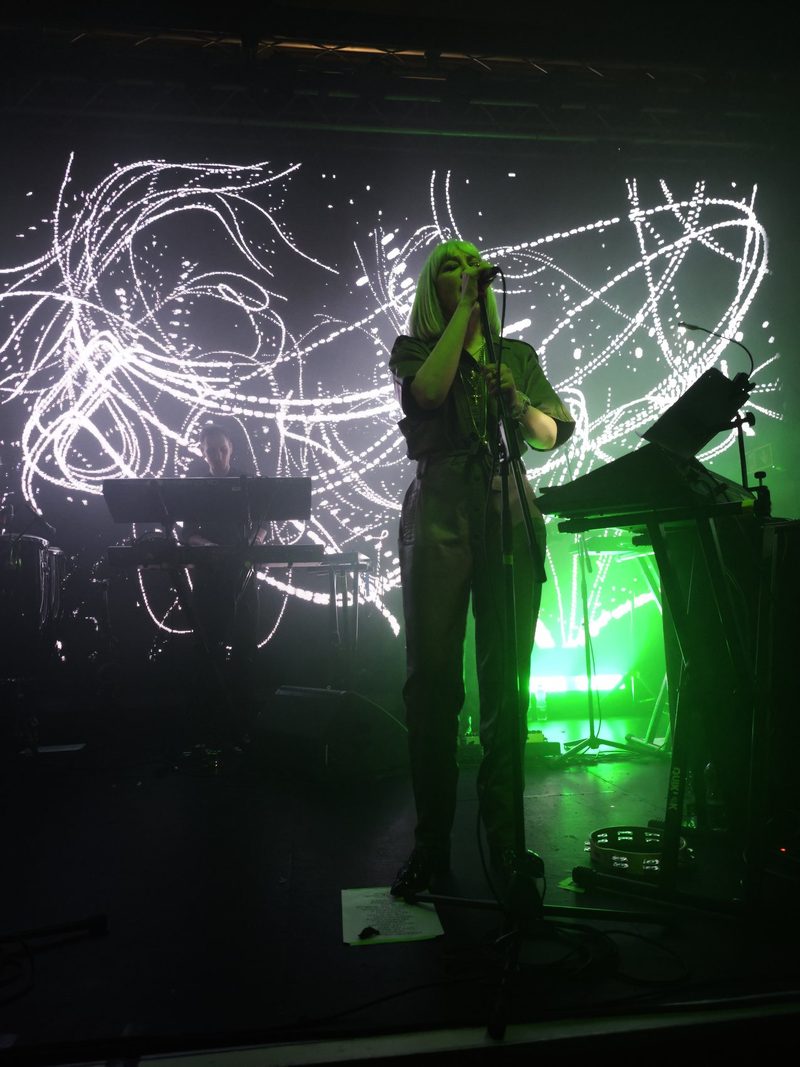
Andrew Hunt, a new addition to the live line-up, offered a contrasting sense of enthusiasm and commitment. Moving between keyboards, saxophone and percussion, he was a far more expressive presence: dancing, gesturing and adding a liveliness that sharply contrasted with Helen and Mira's near-stony restraint. Daniel Hunt, meanwhile, stayed further back—absorbed, effective and discreet, doing his work without claiming an ounce of attention. With Ladytron, that is hardly surprising: this has always been a band whose personality is expressed through self-control rather than exhibitionism.
But the great asset of the night was the sound. There, yes, nothing to object. It sounded loud, very loud, but also clear, very clear. Each layer of the orchestration fitting into its space, the instruments well defined and the volume, although considerable, did not blur the detail. In a band like Ladytron, where electronics, percussion, guitars, voices and superimposed textures coexist, that balance is not a luxury: it is more than half critical. And here it worked. The concert won a lot there. It sounded organic, even more organic than one would expect from a band so associated with the synthetic stigma. That was one of the most successful aspects of the night: the feeling that, beyond the electronic scaffolding, there was body, air, real sound matter, something beating.
The format of the room also helped. The Arts Club Theater offered an intimate, small, concentrated ecosystem, around five hundred people, with a markedly mature audience, a lot of cardboard, a lot of gray hair, little movement; that age group in which one is no longer ready to pretend nor does one want to demonstrate youthful enthusiasm by jumping out of obligation, and at most, shaking one's head. The room had the right size for the concert to breathe without artifice and for the sound to shine without turning into a shapeless mass. There was a contained but receptive atmosphere, more of attentive listening than unleashed euphoria, and that fit quite well with the type of proposal that Ladytron put on stage. Let's not fool ourselves, sometimes the audience does exactly what they see their stage idols do.
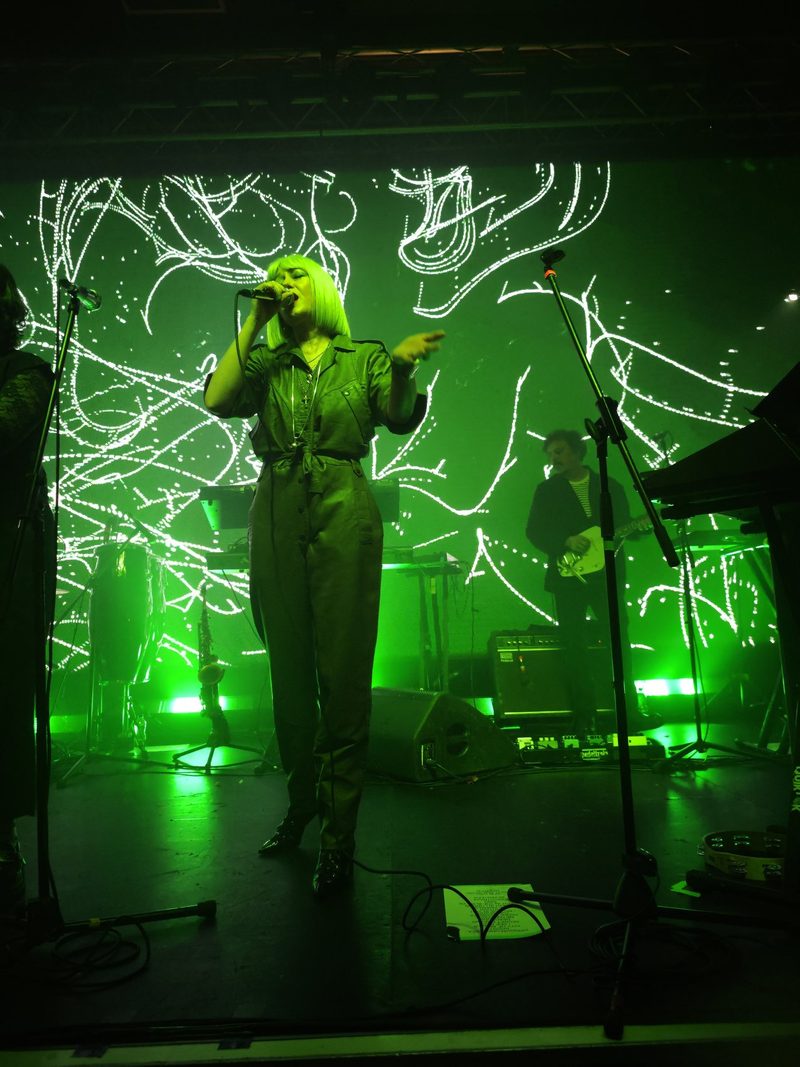
Less convincing was, paradoxically, the visual section. And here there was some disappointment. For a band that has an important audiovisual reputation and whose aesthetic has always played with the idea of immersion, one would expect something more elaborate, more coherent or, at least, more attractive. But it was not the case. The screenings were mostly monotonous, repetitive and somewhat chaotic. Only in two or three songs was there a true communion between music and image, something that truly invited you to look up and get caught up in the combination of both. In the rest, the screen fulfilled a rather decorative role, irregular and at times even irrelevant. It didn't sink the concert, of course, but it didn't elevate it either.
The three-song encore ended with “Destroy Everything You Touch”, the final hit Ladytron keep in reserve like a last bullet, knowing half the room is won the moment it lands. It worked, of course; a song like that could hardly fail. It lifted much of the audience and provided the night's clearest surge of closing energy. Yet even here there was restraint—a clipped electronic edge and the sense of a band setting its sights on a new way of writing and experimenting.

But still, the final feeling was good. Very good, even. Not so much because Ladytron offered a total show, but because they left the impression of being a band that is entering a stage that excites them again. Beyond the impeccable execution, there was in the new songs a kind of internal brightness, a visible warmth, a small illusion due to this reorientation towards a more melodic, softer, more atmospheric sound and less dominated by dance floor logic. It is not a reinvention, nor is there any need for it. But it does seem like a real displacement. And, above all, one that the band seems to be enjoying and where Helen seems to smile again.
Perhaps that is the best way to understand this Liverpool return. It was less a solemn homecoming or grand act of stage reaffirmation than the sound of a band finding a new balance after Reuben Wu's departure and more than two decades of history. Ladytron did not dazzle visually or overwhelm the room head-on, but they offered something more valuable: a solid, elegant and beautifully performed concert, shaped by the sense that this chapter is not a soulless exercise in momentum but a new route forward—one capable of enriching an already remarkable songwriting legacy.
The occasion justified the journey. Travelling almost 2,000 kilometres to witness the live return of a legendary band—one that has moved through the decades without fuss while building an enviable catalogue—proved entirely worthwhile. Experiencing the dreamlike brilliance of “Sign” in the room, with that captivating sound and the musicians fully committed, felt close to transcendence. Ladytron? Yes, please.